
A legal AI tool can find a judgment on the right issue and still miss the point that decides the case. For the lawyer, the first question is whether the judgment supports the answer. But even when the answer is good, what happens next? Does it stay in the chat for more refinement, get copied into an email or become a note for a client meeting?
At the Legal Tech Hub Roadshow in Hannover, we explored what it would take for lawyers to delegate more of a matter to AI while keeping control of the advice. Finding an answer is one part of that work. Checking it, carrying it into the matter and turning it into something a client can use are others.
We started with legal research at Zeno because a good draft depends on sound reasoning. AI can help summarise documents, retrieve legal information and analyse a matter. Yet producing a useful answer is only one step towards producing useful legal work.
The research behind the DELTA Benchmark helps explain the gap. In the Dutch Legal AI Adoption Survey, 115 legal professionals across 19 organisations described their experience of using AI. Almost all, 98.3%, used it at least weekly. Yet 67.8% said the first answer was usable without revision or a follow-up question only half the time or less.
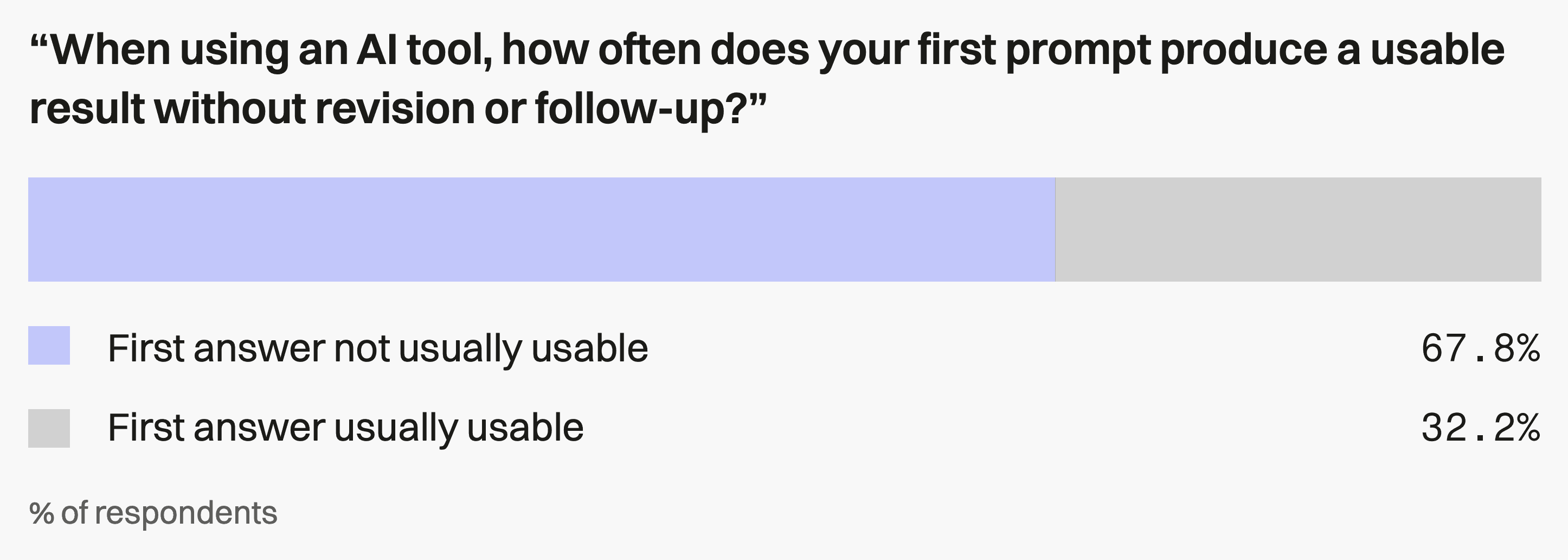
Source: Legal Benchmarks and Zeno, The DELTA Benchmark, August 2026.
These were regular users, not people trying AI for the first time. Their responses suggest that frequent use can coexist with substantial work after the first answer.
DELTA’s evaluation framework looks at substance, citation and form: whether an answer identifies and analyses the important issues, grounds its reasoning in relevant sources and presents the result clearly. A fluent response can still leave the lawyer with important work to do.
The other part of the problem is how the work moves between tools. A firm may use AI for legal research, a separate AI workspace, a document management system with matter files and templates, Outlook for email and Word for drafting. A general-purpose chatbot may sit alongside them. Adding AI can mean adding more places where information needs to be kept current.
Integrations can connect the applications. But the lawyer can still end up doing the connecting work: copying passages, explaining the matter again and reconciling outputs against the latest documents and instructions. Each handover may look small. Together, they can consume much of the time the AI answer appeared to save.
The adoption question is therefore broader than whether AI can do something useful: does the work still hold together when AI becomes part of it?
At the roadshow, we grouped that remaining work into three burdens: verification, orchestration and completion.

What does the judgment actually say?

Verification goes beyond checking that a source exists. Does the quoted passage support the conclusion and reflect the court’s reasoning? Is it current and relevant to this jurisdiction and this matter? What did the research cover, and what remains outside its scope? A lawyer needs to see those limits before relying on the answer.
In the same survey, 82.6% of respondents rated fabricated or incorrect laws, facts or citations as a serious or very serious failure. Reliable sourcing is therefore a practical requirement for useful work.

How legal sources connect
At the roadshow, we used a piste map to explain why the links between sources matter. From the summit, a skier can see the slopes. The map shows which runs connect and where they lead.

Zeno’s legal knowledge graph maps those connections between legal sources much like a ski map. It links a judgment to the provision it interprets and to later decisions that qualify its reasoning. For a lawyer, the value lies in being able to open the relevant passage, read it in context and decide how much weight to give it. If checking the answer requires repeating the research, much of the time saved in producing it is lost.
Keeping the matter current

AI output may look sound and ready to use at first. Then the client changes their instructions, new facts emerge and the matter evolves.
Part of the work sits in a Word draft, another part in an attachment to a recent client email. Further instructions are in Outlook. The lawyer has to bring it all together and make sure the work reflects what has changed.
This is the burden of orchestration: keeping the work aligned with the latest facts, documents and instructions. Connecting applications helps, but the work also needs to retain its meaning.
A colleague reviewing the draft needs to understand which documents and instructions it reflects without piecing the matter together again.
From research to finished work

Once the research and review are complete, the result needs to be ready to use, whether that is an email to a client, an internal memo or a finalised contract.
This is the burden of completion. A good answer in a chat still leaves someone to assemble the relevant facts, qualifications and source trail into a draft ready for final review.
Deciding how to explain a risk to the client is part of the lawyer’s job. Searching a chat for a qualification someone has already checked is another matter. A reviewer should be able to go from the relevant sentence in the draft to the passage it relies on.
These burdens compound. Lost context creates more verification work. When sources are hard to trace, it slows the review. An unfinished draft sends the lawyer back through the conversation to reconstruct decisions. Tools can address each challenge separately. The harder task is bringing all three together while preserving legal quality and the lawyer’s judgement.
What a firm can delegate
For a firm evaluating legal AI, it is worth following a real matter beyond the first answer. Can a lawyer check the reasoning? Does the work remain aligned when the facts or instructions change? Can a colleague review the resulting draft without reconstructing the chat?
We are building Zeno Work to bring legal research, matter documents and drafting together. The aim is to reduce the work of checking, transferring and assembling information while keeping the lawyer in control of the conclusions.

